It began with the National Cemetery
19 October 2018
I greatly enjoyed a rainy afternoon last Thursday in Sharpsburg, spending part of it at the Antietam National Cemetery. I’m working on a project tracing the history and evolution of the Antietam National Battlefield, and the Cemetery, created shortly before the Battlefield was established, is a big part of that story.
But it is also a beautiful place in its own right, so I hope neither of my readers will object if I hit some highlights.

Summer fly-by visit
12 July 2017
On the return leg of an excursion north to visit family and friends, we made a stop at the Battlefield last Sunday. It was a glorious day, as is so often the case there, and perfect for catching up on some of the changes at the Park.

First stop after checking in at the Visitor’s Center was the recently restored Lower (Burnside’s) Bridge.
Anniversary Visit 2015
22 September 2015
It was another fantastic day in Sharpsburg on the 153rd anniversary of the battle. I was very glad to be there for an early morning visit. Here are some quick snaps and impressions.
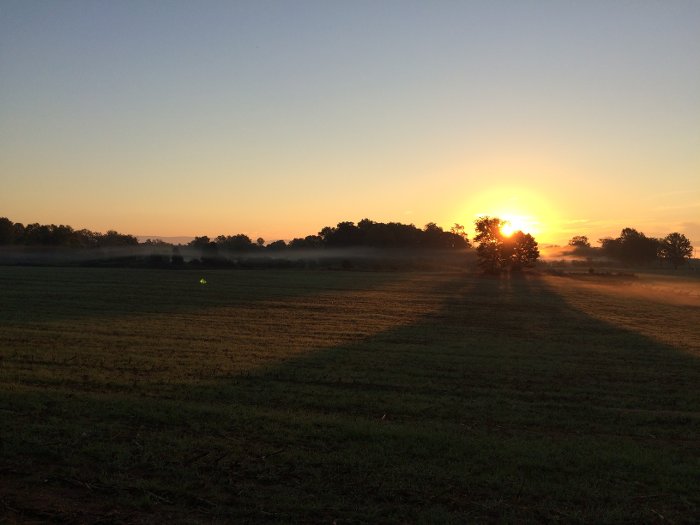
Sunrise at Antietam National Battlefield, 17 September 2015
I made it to the Park in time to join the 7am group – off the turnpike and through the wet grass to the Northern edge of farmer Miller’s cornfield – to hear the the now-traditional readings of eyewitness accounts of the long night and early dawn of 16-17 September 1862.
Antietam 150: Anniversary Sunrise
17 September 2012
From the end of the day of the 150th Anniversary of the Battle of Antietam, a couple of quick shots of how it looked at its start.
First, early dawn horizon behind the 14th Brooklyn Monument at the south edge of The Cornfield.

Then, the sun slightly higher from within the corn.

Finally, full daylight; a little black powder smoke lying low over the Cornfield.
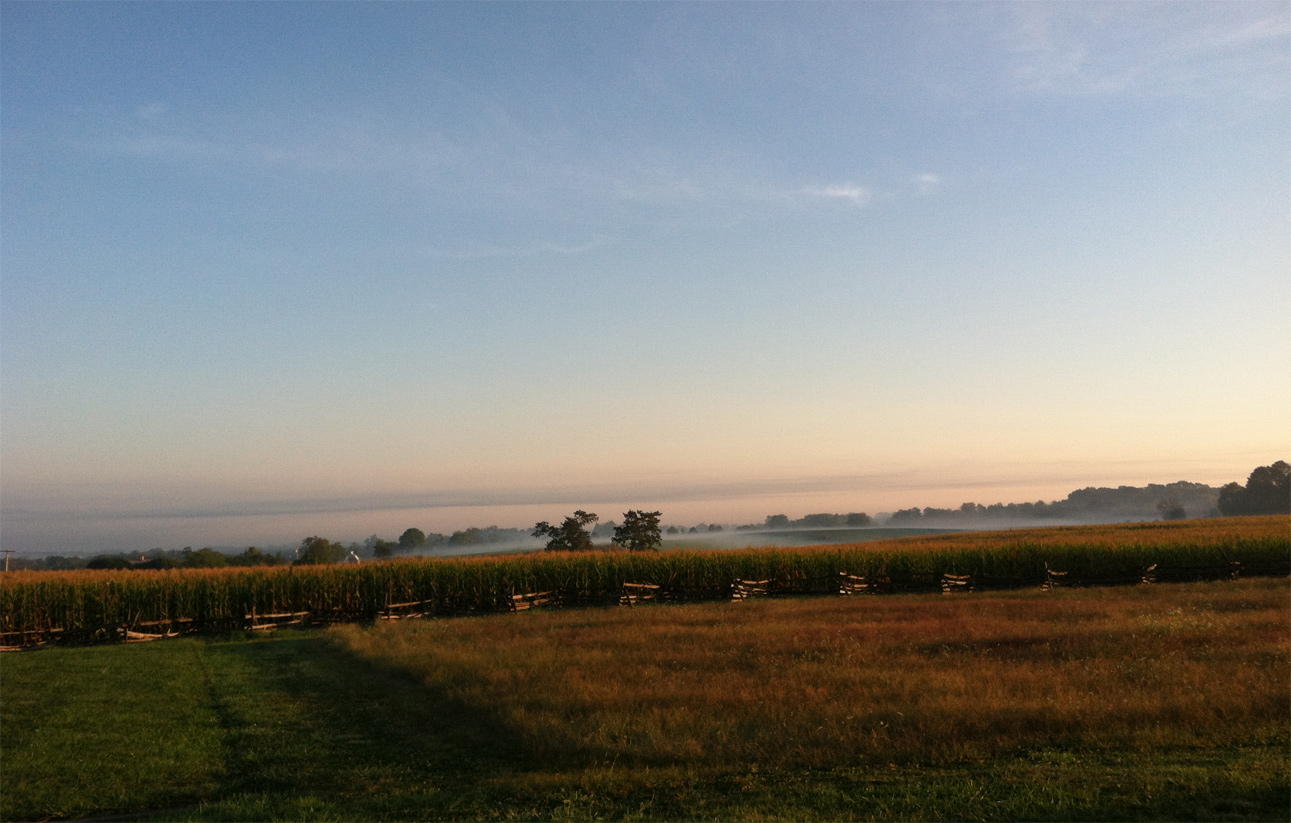
Antietam Illumination
15 November 2009
One of the most moving experiences you can have anywhere is driving through the battlefield during the annual Antietam Memorial Illumination. This year the tradition returns on Saturday, December 5th to the Antietam National Battlefield, Sharpsburg, Maryland.
On that evening, volunteers will light over 23,000 luminaries – candles in small paper bags – distributed across the Park to represent each of the soldiers who were casualties on that ground on 17 September 1862.
New AotW member Tim Dicke has sent us some of his photographs from last year’s event. It can be tricky to capture any kind of image of those little flickering lights, but Tim has done a fine job of illustrating something of what it’s like at the Illumination.

Vermont Brigade Cannon
Near anniversary 2009
20 September 2009
Saturday was another great day to be at the Antietam National Battlefield Park.
It began early for me with an uneventful drive up the National Pike route, and a SHAF meeting in Keedysville which introduced promise of more website improvements and some exciting initiatives for the organization for the near future.
After a photo-op at the battlefield Visitor Center and a low-fat gourmet lunch at the Battleview, I walked the newish Bloody Lane Trail with Craig Swain. Craig is a former Armor Officer and an excellent companion in the field. Thanks Craig!
As I always find when walking a part of the field I hadn’t seen before, the new perspective brought me an entirely different appreciation of the history of the place. And some new views that I enjoyed for their own sake…
Antietam: Blogger’s Tours 2009
23 November 2008
It’s below freezing and we’ve seen snow flurries here in Northern Virginia. A good time to burrow in and wish for Spring. Or at least for warmer battlefield tramping weather.
I am inspired to plan some serious hikes by the news that the new Three Farms Trail is open at Antietam National Battlefield. Roulette, Newcomer (below), and Sherrick, are the three, I’d guess. This new path ties together a network of 9 trails which covers much of the battlefield terrain which saw combat 17 September 1862.
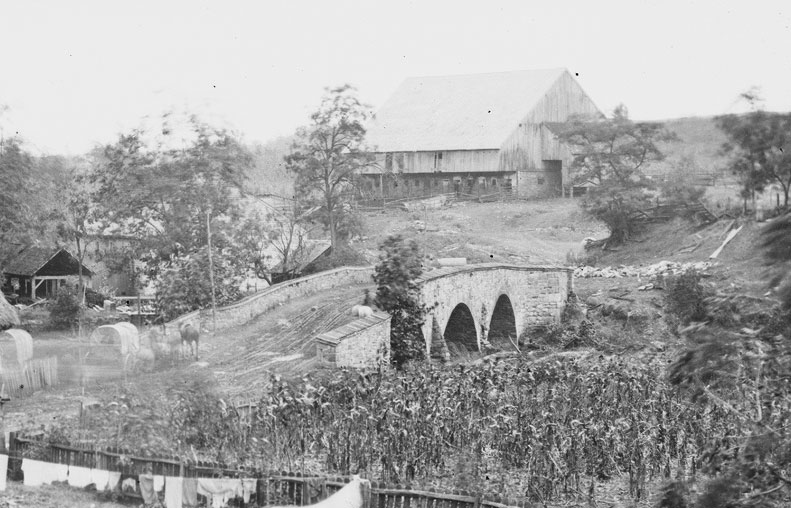
So, with a goal to follow all of the trails and tramp the whole battlefield in a season, I’m wondering what would be the best way to do it? I’ll take a shot at a plan over the next few weeks … who’s with me?
On the trail of the Corn Exchange Regiment
5 October 2008
146 years to the day after the historical events, a lucky group of us tracked the unlucky 118th Pennsylvania Volunteers to the places and views of the Battle of Shepherdstown Ford (20 September 1862). Under the capable guidance of Dr Tom Clemens and members of the Shepherdstown Battlefield Preservation Association (SBPA), we waded the Potomac, scaled the heights, and walked the field.
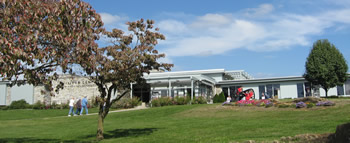
ANB Visitor’s Center – a postcard perfect day
We gathered Saturday the 20th at the Antietam Visitor’s Center, drove in convoy to the Dunleavy spread near Shepherdstown, WV, and then carpooled to the Chesapeake & Ohio (C&O) Canal Park [NPS site] back on the Maryland side of the Shepherdstown (Boteler’s, Packhorse, Blackford’s) Ford…
Stalking the wild model 1857 12-pound light gun-howitzer
14 September 2008
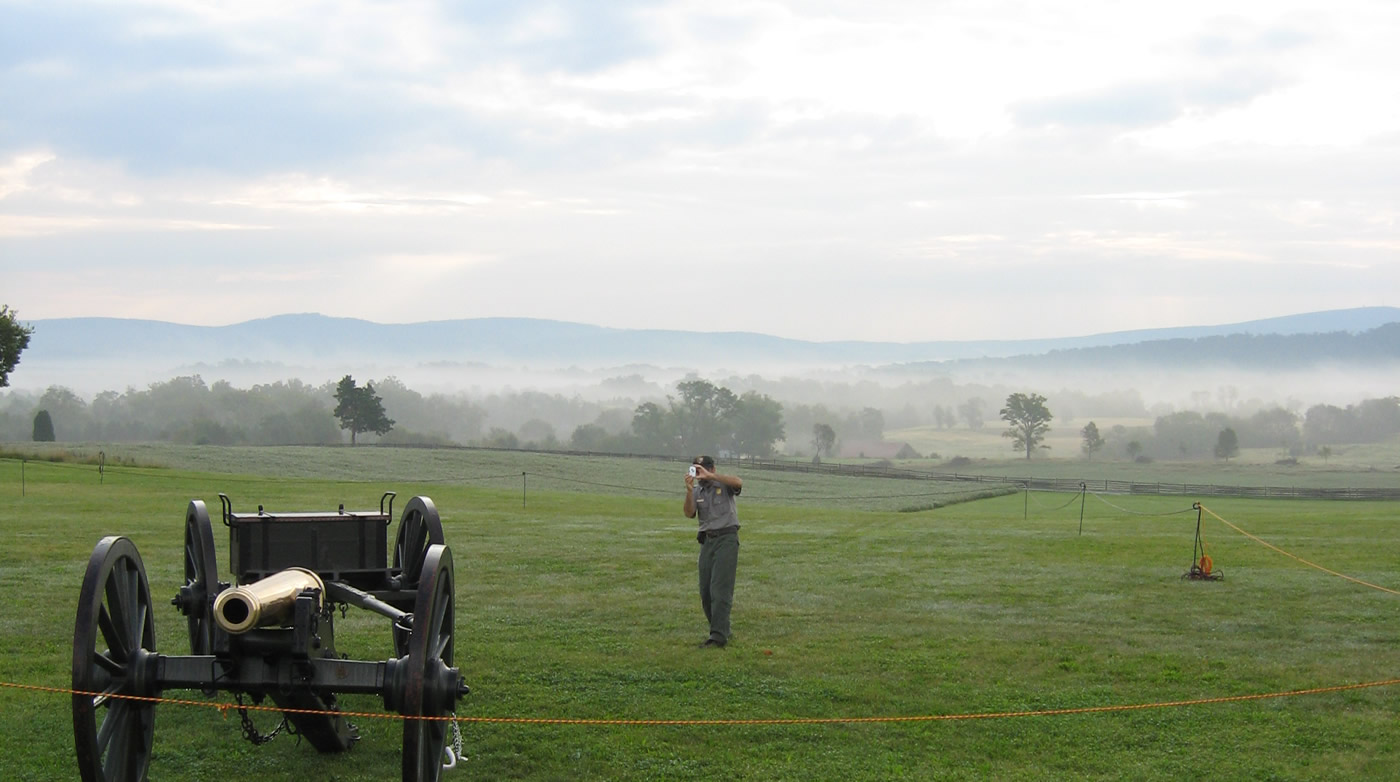
Mannie sneaks up on the prey
I drove through the fog to Sharpsburg yesterday, much earlier than is usual for me to be up on a Saturday. Arrived too early for the ANB Visitor’s Center to be open, in fact, but in time to catch Mr. Mumma cutting blossoms to place inside. Ranger Mannie was out early, too.
Get to the best battlefield park on the planet
8 September 2008
Still no time to blog, more’s the pity. Life intervenes. But I’m making time for a couple of trips to Sharpsburg in this Anniversary month. I hope some of you can join me.
Next weekend – the 13th and 14th – will be the biggest of the year at the Park. The Park Service page for the Anniversary events has all the information. I haven’t decided yet which event specifically, but will be there early Saturday morning, so I’m leaning toward the first hike going off at 8am called the Opening Guns: the role of Artillery on the morning of 17 September 1862.
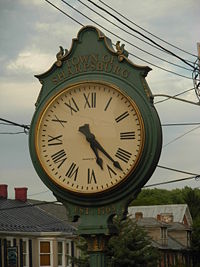
The annual Heritage Days festival is in town in Sharpsburg the same weekend. I plan to catch the three SHAF historical speakers Saturday afternoon, at least. Much to do in Sharpsburg all day (and Sunday). Steven Recker is doing his O.T. Reilly tour of the town both days at 1pm, too. I can’t do that one, but hope you got a spot: he’s only taking 25 each day.
There’s also the annual battlefield tradition of the all-day hike on the battle anniversary date, proper. This year, as it did in 1862, September 17th falls on a Wednesday. If you can get there, you can spend the day chasing the battle action (and an intrepid Ranger or two) across the whole field in approximate time-step with the sequence of events.
The following weekend I’ll return to the area to wade the Potomac Saturday, where the Army of Northern Virginia crossed back into Virginia after the battle of Sharpsburg. In this case chasing Dr Tom Clemens on a tour of the ford and battle area of 20 September 1862. A rare opportunity I’m looking forward to grabbing, thanks to our friends at the Shepherdstown Battlefield Preservation Association (SBPA). There may be food and beverages. Bonus.
______________
I’m still working on the second installment on Federal artillerist Horatio Gibson (part one now months back). Presently having fun with one apparent aspect of his personality which I’ve also seen in a particular type of modern military officer: the ringknocker. If you recognize the term.
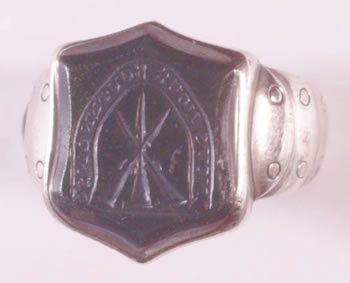
Here’s the ring, which is all you get til I finally post …. the rest of the story.
 [
[