

Lucius C Mix, late First Lieutenant, 33rd New York Infantry, engraved a series of illustrations for David W Judd’s 1864 Story of the Thirty-third N. Y. S. Vols: or Two Years Campaigning in Virginia and Maryland.
Here’s his rendering of the site of his regiment’s combat near the West Woods at Antietam on 17 September 1862.
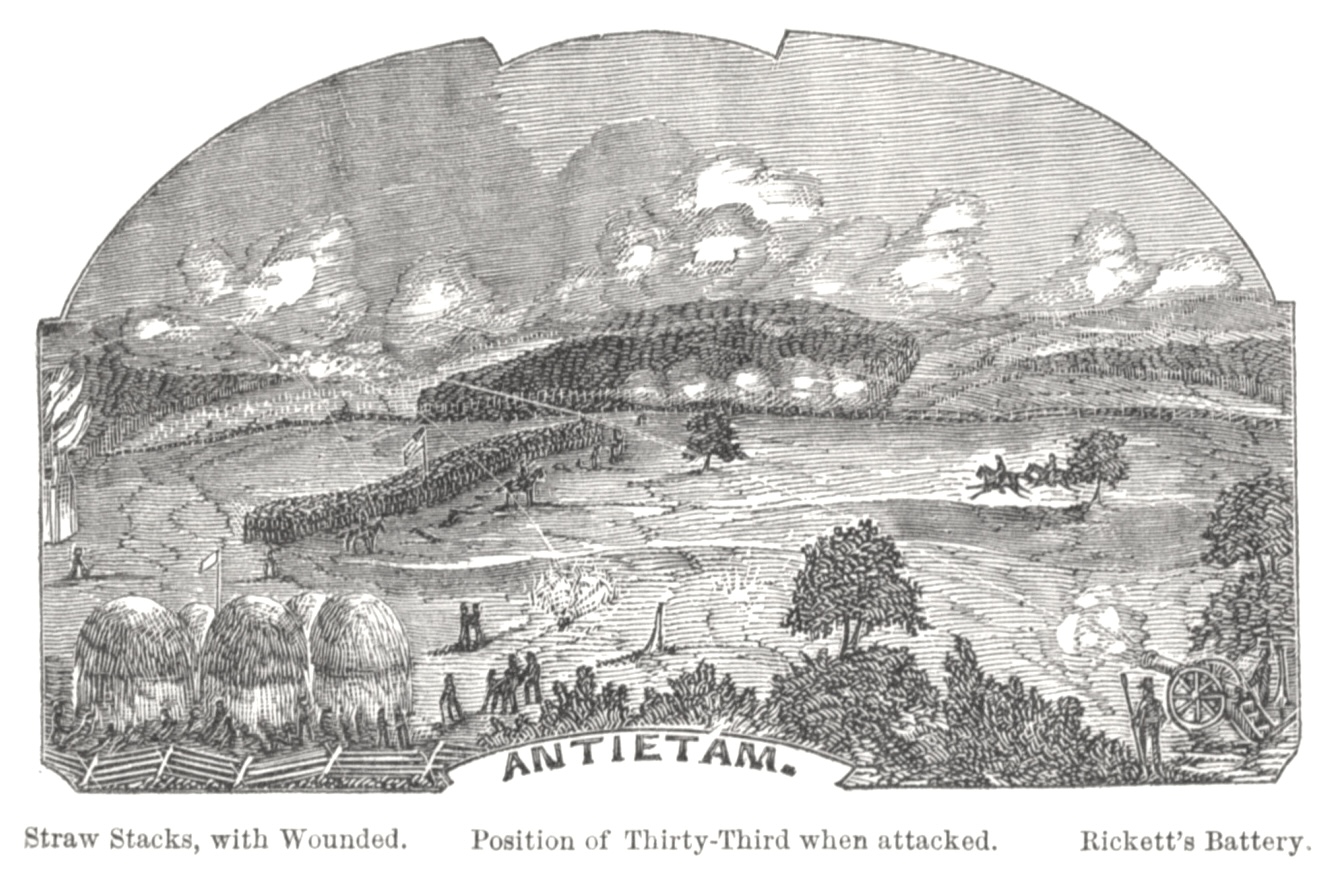
The 33rd New York, part of Irwin’s Brigade in General Franklin’s 6th Army Corps arrived on the battlefield about midday on the 17th after a march of some 8 miles that morning from their previous position in Pleasant Valley near Crampton’s Gap on South Mountain.
The brigade was pushed forward to relieve remnants of the Union 1st and 12th Corps, and formed line across the Smoketown Road near the Mumma Farm. They then …
charged through the Batteries and across the fields in their front to check the advance of the Confederates from the West Woods. The direction of its advance was south of the Dunkard Church and, when its right Regiments, the 33d and 77th New York, were nearly abreast the Church, they received such a destructive fire on their right and rear as compelled them to retire to the cover of the ridge in front of the Church …
In Lieutenant Mix’s drawing, you can see a burning building at the far left, presumably representing the Mumma house.
That helps us orient this view – looking south from a spot on the Miller Farm: the 33rd New York and the other men of Irwin’s Brigade at left center, and elements of a force of Confederates coming from the direction of the West Woods at our right.
“Rickett’s Battery” at lower right refers to Battery I of the First United States Artillery commanded by Lieutenant George A. Woodruff – who were certainly in action near the West Woods earlier in the day, but were probably not nearby by the time Irwin’s Brigade arrived.
There were several Federal batteries to their right and rear – they would have been seen at the middle-left of Mix’s view, had he included them.
For reference, here’s a portion of the Antietam Battlefield Board’s map of the field showing unit positions and movement at about 1pm that afternoon (north at the top).
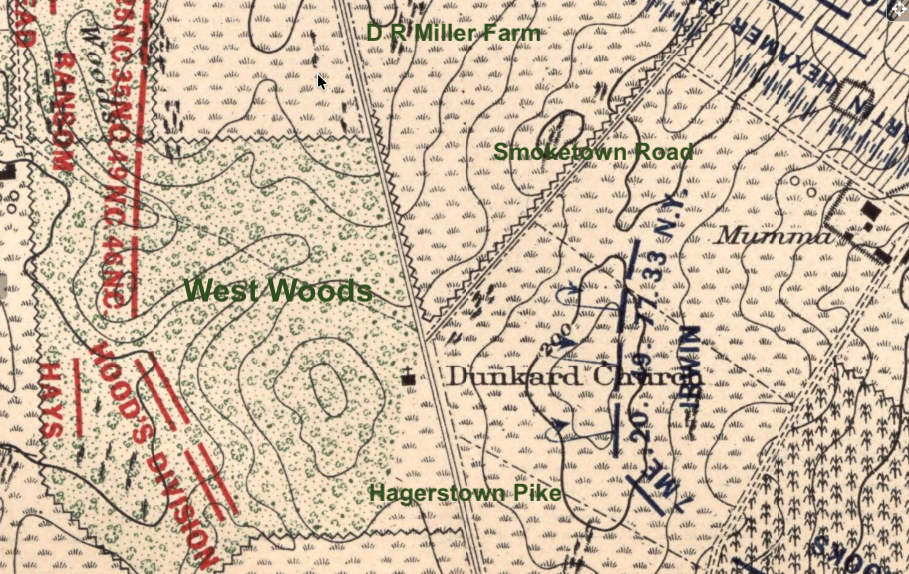
Lieutenant Mix only saw part of that action first-hand: he was wounded there by a gunshot through his left thigh and helped to the rear by his regiment’s Sergeant Major George Bassett. Sadly, Basset was shot through the head and killed when he returned.
It is likely Mix was himself initially treated behind a haystack on the Miller farm, which would explain why he gave the stacks and the wounded so much attention in the foreground of his illustration and why he chose that vantage point.
Notes
David Wright Judd (1838-1880) wrote for the New York Times during the war, and was later editor of Hearth and Home, politician, author, and president of Orange Judd Company, the family publishing business.
Judd’s Story of the Thirty-third N. Y. S. Vols is online from the Hathi Trust, source of Mix’s Antietam engraving.
The narrative of the brigade’s actions at Antietam is from their battlefield tablet, text by battle historian Ezra Carman.
The map section above is from the 1:00 p.m. page in the Atlas of the Battlefield at Antietam (1908), online from the Library of Congress.
Leave a Reply