Sound of the Guns
29 January 2008
Another new Civil War-themed blog has arrived. Craig Swain has created To the Sound of the Guns*–perhaps the perfect name for such a blog. His stated purpose is
to aid the organization and presentation of my research, notations, and observations regarding the study of American history, in particular the Civil War. This study currently manifests itself in two directions – cataloging of historical markers and site visits to Civil War battlefields.
He calls himself a Marker Hunter, and Craig’s a prolific contributor to the growing Historical Marker database (HMdb); he talks about his collection captured on Maryland Heights last Fall in today’s post.
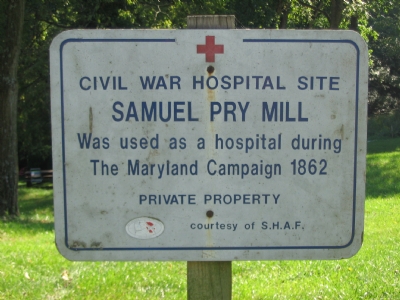
Pry Mill marker (C. Swain)
In the previous post he introduced some Maryland campaign hospital markers erected by SHAF that I’d not seen before. Great stuff.
Welcome to the ‘sphere and continued good hunting, Craig!
______________
* From an H-Net discussion of 1996:
My esteemed friend Col. M.L. Lanning (whose many books on VN and other military matters are much commended) has provided the following, concise information concerning the adage about “riding to the sound of the guns”:
David:
Re: DICTIONARY OF MILITARY AND NAVAL QUOTATIONS by Robert D. Heinl, Jr. (Annapolis, MD: U.S. Naval Institute Press, 1967)
page 141 “March to the sound of the guns.” credited to “Military Maxim”
but more likely page 140 “As a general rule, the maxim of marching to the sound of the guns is a wise one.” by Baron Antoine H. Jomini 1779-1869, (a member of Marshal Ney’s staff and the author of “Art of War”) This quote is from Precis Politique el Militaire de la Campagne de 1815.
As you can see, it is “march” not “ride.” Once again the damn cavalry tries to take credit from the infantry.
Regards,
Lee
Civil War Florida
28 January 2008
A little behind, as usual, I’ve just found Dale Cox’s Civil War Florida blog. He’s been at it since September 2007, and his latest post considers one of my Sharpsburg guys, Captain Harrison Tillinghast, Company F, Second Florida Infantry.
Mr Cox has introduced quite a number of Florida CW landmarks and individuals since he began blogging. I have much catching up to do: there’s a wealth of material in about 125 posts in the five months to date.
I’ve particularly enjoyed some of his accompanying personal photographs, like this one of Santa Rosa Island (related post).
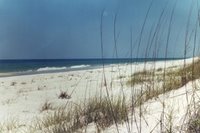
Having been stationed at Pensacola briefly some years back, I can almost smell that beach …
The author also mentions his publications from time to time, and is proprietor of Explore Southern History – a project he identifies as his main website.
A belated welcome to the blogosphere and best wishes to Dale!
National Pike blogged
25 January 2008
I’ve just stumbled over a fascinating project of Christoper Busta-Peck’s covering the Old National Road/National Pike. You probably know that part of that historic thoroughfare was on the path of the Armies during the Maryland Campaign of 1862.
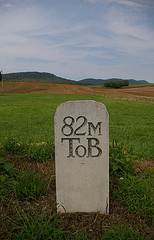
National Pike milestone, recreated (C. Busta-Peck)
Christoper is a librarian at the Enoch Pratt Free Library in Baltimore, and is using the blogging medium to perfection, as I see it, to illuminate history right under our noses. History, I dare say, most of us have missed. Do go see his excellent use of GoogleMaps to cover the milemarkers and other sights along the Road, in addition to the range of other fine posts on the subject.
When he started in September 2007, Christopher explained:
This blog is my attempt to describe and share my journeys on the National Pike, as it winds its way from Baltimore to Cumberland, Maryland, as well as the National Road, from Cumberland, Maryland, to Vandalia, Illinois. I plan to include plenty of photographs, maps to describe the journey.
The blog post that finally caught my attention today is about the series of 19th Century stone bridges over the Antietam and the 1910 book on the subject by Helen Ashe Hays. He’s scanned and posted the superb photos from that volume. Both of my readers will immediately recognize the spans in his post as brothers and sisters of what’s now known as Burnside Bridge.
Bravo. Brilliant!
 [
[