The very image of a soldier: A. V. Colburn
5 January 2008
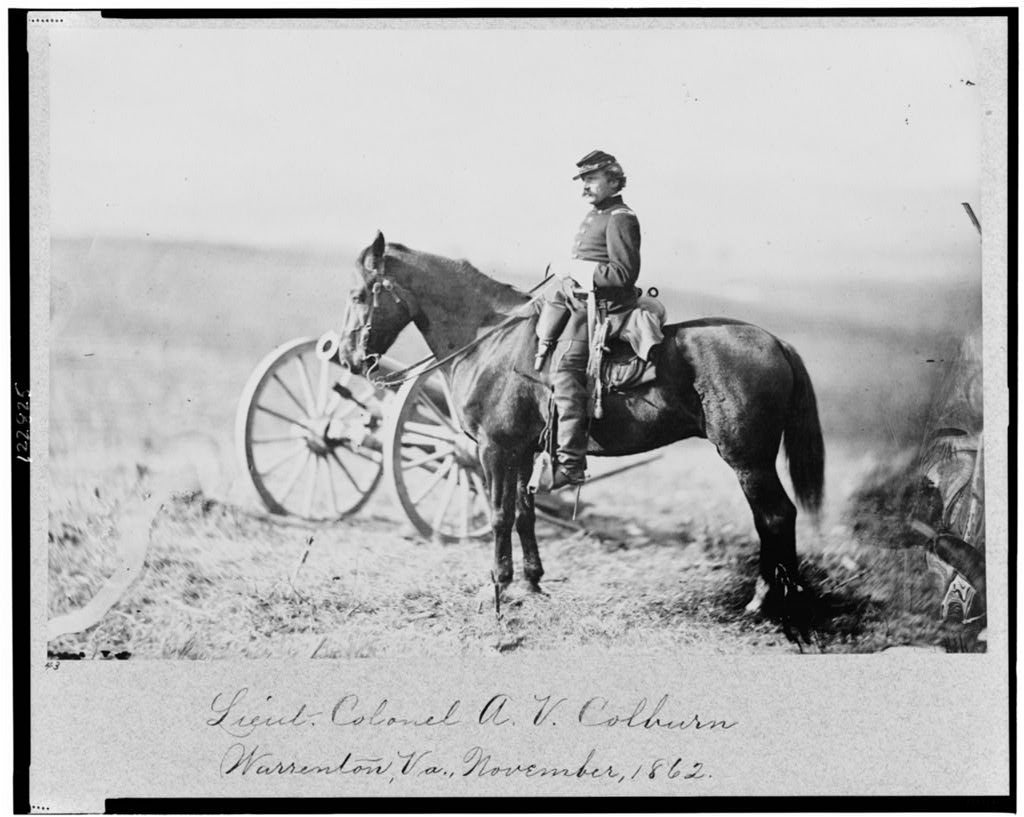
Lieut.-Col. A.V. Colburn, Warrenton, Va, November 1862 (studio of M. Brady, Library of Congress)
A brand new Lieutenant at First Bull Run in July 1861, George A Custer later recalled with envy a gallant charge by a squadron of the 1st US Cavalry under Capt Colburn early in the battle. The charge may not have actually happened, which is sad for the romantics like Custer, particularly as the first major battle of the War was Colburn’s last in hands-on field command.
Albert V. Colburn is best known now as Assistant Adjutant General (AAG) to George McClellan during the General’s terms in command of the Army of the Potomac. Students of that army will come upon Colburn’s name frequently–on orders, reports and letters–as he so often served as the voice of the General Commanding.
Let me offer just a little more about the man behind the signature …
Private soldiers
30 December 2007
Every so often I hear from descendants of soldiers who were at Sharpsburg in September 1862. Many ask why their ancestor is not already among those profiled on Antietam on the Web.
Well, the obvious–if selfish–answer is that it’s taken me about 12 years to get to approximately 1100 individuals. That these are something fewer than 1% of all those present on the Maryland Campaign suggests I may not have enough lifetime to get to them all.

unidentified Connecticut Sergeant (coll. Andy de Cusati)
The main reason I don’t have anything online about the vast majority of the troops is that I don’t know about them. To date I’ve been working through the senior officers, men commanding regiments and batteries, and “celebrities” like Medal of Honor recipients, post-War memoirists, prominent local civilians, and others who stood out from the crowd during and after the War. By definition these include very few of the ordinary soldiers who were the bulk of the participants.
I’ve been considering lately how I might import information about large numbers of soldiers in batches, but worry about introducing inaccuracies as a result. I know some units are well documented digitally (thanks to people like Steve Soper and Jim Studnicki, for example), but such information is not universally available. Date-specific rosters or muster reports are particularly spotty for Confederate units, which would make an apparent Federal bias in our database even worse.
I would still like to get more of the troops’ names and lives online, but don’t yet have a practical means. I’ll pick away at this problem as I can.
In the meantime, though, I’m taking advantage of the same family members who ask about their soldiers. Most have been very knowledgeable, and extremely generous in sharing with Antietam on the Web. Let me tell you about two such cases that came in just before Christmas …
Battery Commander Elijah Taft
12 December 2007
I’ve been looking into one of the artillery officers I mentioned last week, Captain Elijah Taft. I had nothing on him to begin with, and he’s still an enigma to me today.

5th NY Battery monument, Gettysburg (New York at Gettysburg)
I prefer to bring you well-rounded posts when profiling the soldiers at Antietam, and usually I can give you something deeper than places and dates. In Captain Taft’s case, though, all I really have are some tantalizing hints to the man’s life. Questions with ties to facets of 19th Century American history I know too little about.
 [
[