Seeking Private Freudenthal at Antietam
13 March 2007
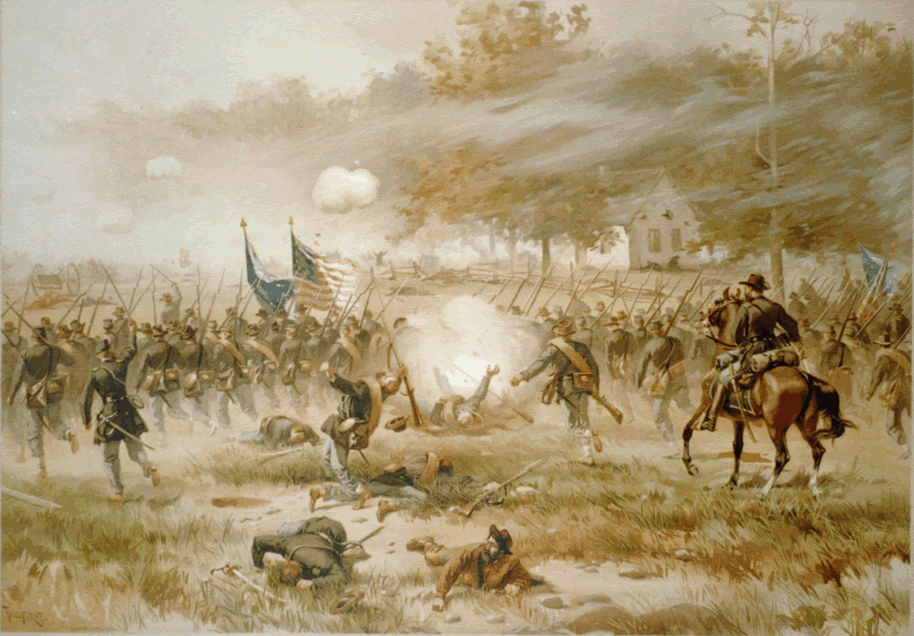
Thulstrup’s Antietam (1887)
This famous print, from a watercolor by Bror Thure de Thulstrup, is behind a great story sent me by email from a great-granddaughter of the late Gustav August Freudenthal, once Private, Company K, 20th Regiment, New York Volunteer Infantry.
The story is that Freudenthal told his family he is pictured in the painting.
It seemed unlikely on first hearing, but I thought I’d dig about a little to be sure …
Oliver D Greene and the poison pen
1 March 2007
I had a kind email from the g-g-granddaughter of Oliver D. Green, medal of honor recipient and staff officer at Antietam. She corrected my error on AotW in his middle name (it’s Davis). I’m very glad she brought him to my attention.
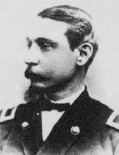
Oliver Davis Greene
A career Regular Army officer from west-central New York State, Oliver Davis Greene graduated from West Point in 1854 and saw duty in the West with the 2nd US Artillery Regiment. At the start of the War in 1861 he was 1st Lieutenant, Battery G, and was in action as the battery’s commander at First Bull Run in July. He was then assigned as Captain and Assistant Adjutant General (AAG) on Major General Don Carlos Buell’s staff.
In that service Captain Greene made a powerful enemy: Andrew Johnson, then military governor of Tennessee. In 1864, of course, Johnson was elected Vice-President of the United States, and became President himself on Lincoln’s assassination in 1865.
It was at Nashville in the summer of 1862 that Greene and Johnson bumped heads …
McClellan on the field at Antietam
2 February 2007
I have some follow-up to the last post, about General McClellan dashing over the field during the battle of Antietam on 17 September 1862. Happily more battle illustration is required in accompaniment.
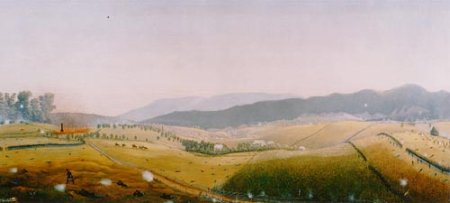
A Fateful Turn: Late morning looking east toward the Roulette Farm (James Hope via ANBP)
This is one of the five famous Hope Paintings, a series of very large panoramic views painted by battle veteran James Hope working from sketches he made during the battle. These were first exhibited to the public in or after 1872 at his Watkins Glen studio.
The Park Service notes describe this picture:
… burning Mumma Farm is seen on the left, and Gen. George McClellan is riding with his staff on his only visit onto the battlefield that day at about 2:00 pm. On the right, Richardson’s and French’s Union Divisions advancing on Bloody Lane.
Is this further evidence of McClellan’s whereabouts on the field or artistic interpretation?
 [
[