Rufus Pettit: solid artilleryman, vicious jailkeeper
28 October 2006
I should avoid online Civil War discussion groups. They just give me more research threads to pull. Like I need more.
I’d been following a discussion about artillery over on the American Civil War Message Board. I was thinking I could contribute on a question about unit organization, which referred to Battery B, 1st New York Light Artillery, as an example.

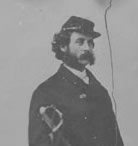
R.D. Pettit, c. 1861-65
First, I looked to see what that battery was doing at Antietam, and noticed the commander was Captain Rufus Petit (above). I didn’t have much on the Captain, but did know that he had been dismissed from the service in 1865. I wondered why. He seemed to have served honorably on the Peninsula and at Antietam. “Dismissed” is usually bad.
1860 Federal census hits the street
25 October 2006
Dimitri Rotov was blogging about numbers and wondering if Federal Generals had available the 1860 population figures for the South. Data that might support large numbers for a Confederate field army. At least in retrospect.
Well it’s not central to any argument, but I was curious. So I asked the nice folks at the US Census Bureau when the results of the 1860 Census were published, and when/if the President and Army officers might have had an advance peek. The answer’s just in:
A preliminary report of the 1860 results was printed in May 1862. The final report of the 1860 census was contained in four volumes: population (1864), agriculture (1864), manufacturers (1865), and mortality/miscellaneous statistics (1866).
Data were likely available before publication of the final reports. The preliminary report was approved by Congress and printed within the same month (May 1862), so any advance look at the data may have been measured in days.
History Staff
So there you are. Army commanders would have had access to Southern population figures after May 1862. Doesn’t help much in 1861 or earlier in ’62, of course.
These preliminary numbers did break out population by place, race, and gender, but not by age. A military-aged (white) male population could be estimated or calculated by formula, but is not expressly given.
It’s interesting that the data were available, but it would be more meaningful to know if anyone actually used census data for the purpose of evaluating or confirming enemy numbers. Anybody got any evidence for this, either way?
Was this kind of analysis taught at West Point or otherwise known before the War, such that McClellan or any other senior officer was likely to do it?
Inquiring minds.
Selling-off more history
24 October 2006
Writing previously on this subject, I worried about a soldier’s wartime letter disappearing into a private collection, never to be seen again. That was as nothing compared to what I found online today. Oh how I wish now I’d gone for the money instead of personal satisfaction and life-balance in my career choices.
Cowan Auctions is selling a mass of Americana on November 16th. There are some truly magnificent finds for the student of the American Civil War listed in the catalog. This looks like a wide array of archives and artifacts.
I’d be overjoyed if collectors of historical ephemera would publish online, or loan to museums, or at least make scans or transcriptions of their treasures available to the rest of us. In the meantime, I’m snatching digital samples related to Antietam and the Campaign as they go by.
After a little more research, I expect to use some of this material on AotW:
W.W. Blackmar
I have a special fascination with Medal of Honor recipients. One I’d not previously associated with the Maryland Campaign is Captain Wilmon Whilldin Blackmar of Boston. That’s him above, from a gilt-framed CDV, part of Lot 232 (est. $3,000-4,000). Blackmar
… enlisted as Corporal in Company K, 15th Pennsylvania Cavalry in August 1862. The novice regiment participated in the Maryland campaign before transferring west to join the Army of the Cumberland in December 1862 …
read the rest of this entry »
 [
[