Fine day in Western Maryland
27 May 2006
Sharpsburg claims one of the original Memorial Day parades in the United States. Begun soon after the war as Decoration Day, the celebration was to honor the soldiers of the Civil War … Later … the parade drew thousands of people to Sharpsburg to see the many marching bands, dignitaries and costumed school children.
Today the tradition continues … Saturday afternoon of Memorial Day weekend.
Had I done my homework, I wouldn’t have this afternoon wandered into the biggest traffic jam Greater Sharpsburg has probably seen all year.
Even with that, it was still the best day in a month, for me, easy.
I began my trip to the Park this morning with a planned stop in Burkittsville to visit briefly with Tim Reese to help him thin his library. I’m afraid I ate up his morning, but we had a great chat, and it was very good to put a face and voice to an online friend.
It was an enlightening drive there, thanks to the route Tim suggested. West from Frederick, I topped the Catoctin Ridge on US340 and was dazzled by the view. South Mountain was clear and sharp from the water gap at Weverton to Crampton’s Gap and a little beyond.
Go Chargers
25 May 2006
I’m sorry to say I’d never heard of Hillsdale College until last week.
My loss.
In south-central Michigan, Hillsdale was a hotbed of liberal thought, abolitionism, and Unionist sentiment in mid-19th Century America.
Because of its dedication to the principle of equality, Hillsdale became an early force for the abolition of slavery and for the education of black students; in fact, blacks were admitted immediately after the 1844 founding. The College became the second in the nation to grant four-year liberal arts degrees to women …
… Because of its early crusade against slavery, its role in helping to found the Republican party in Jackson in 1854 (President Edmund Fairfield was a leading founder of the party), and its location on the first railroad to pass through Michigan to Chicago, Hillsdale College was a natural site for more than two dozen nationally recognized speakers in the antebellum and Civil War eras … Frederick Douglass, Edward Everett, Governor Austin Blair, Senator Zachariah Chandler, Senator Charles Sumner, Carl Schurz, Wendell Phillips, Senator Lyman Trumbull, Owen Lovejoy, and William Lloyd Garrison …
I’m guessing this tradition, those speakers, and the political bent of the school administration fired-up the students. In 1861, shortly after Fort Sumter, a great number of them enlisted, many in the 4th Michigan Infantry. By the end of the War more than 400 students had served – reportedly a higher proportion of the student body than any other Northern school save West Point. Half were commissioned officers. Among them also were 4 Medal of Honor recipients and 2 general officers. 60 of them gave their lives.
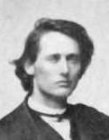
M.A. Luce
It was one of Hillsdale’s MoH winners that twigged me to the school and its Civil War history. Moses A. Luce‘s name came up when I was researching his commanding officer in the 4th Michigan at Antietam, Colonel Jonathan W. Childs. Luce was later awarded the Medal of Honor [citation] for retrieving and returning with a badly wounded fellow Sergeant – and Hillsdale man – under fire near Spottsylvania Courthouse in 1864.
Fishel: Secret War for the Union
18 April 2006
As mentioned in an earlier post, I’ve been reading Edwin C. Fishel’s The Secret War for the Union : The Untold Story of Military Intelligence in the Civil War (Houghton Mifflin, 1996). In particular, I was hoping to gain some insight into how General McClellan arrived at the strength figures he used for General Lee’s forces in Maryland in 1862.

I’m about halfway through, just past The Battle, but I don’t think I’m going to be able to finish.
This is one dry read. You’ve got to be truly dedicated to slog through it. It is a book which could have used a strong editor. I’d say 1/2 to 2/3 of the text is redundant or otherwise unnecessary. There is little structure – the book has been one seemingly endless, chronological string of anectodes and factoids.
There are gems of new and important discovery, but they play hard-to-get. I’m probably going to miss many by not staying to the end.
That aside, how did McClellan come to a grossly inflated figure for the size of the army facing his at Sharpsburg?
 [
[