Go Chargers
25 May 2006
I’m sorry to say I’d never heard of Hillsdale College until last week.
My loss.
In south-central Michigan, Hillsdale was a hotbed of liberal thought, abolitionism, and Unionist sentiment in mid-19th Century America.
Because of its dedication to the principle of equality, Hillsdale became an early force for the abolition of slavery and for the education of black students; in fact, blacks were admitted immediately after the 1844 founding. The College became the second in the nation to grant four-year liberal arts degrees to women …
… Because of its early crusade against slavery, its role in helping to found the Republican party in Jackson in 1854 (President Edmund Fairfield was a leading founder of the party), and its location on the first railroad to pass through Michigan to Chicago, Hillsdale College was a natural site for more than two dozen nationally recognized speakers in the antebellum and Civil War eras … Frederick Douglass, Edward Everett, Governor Austin Blair, Senator Zachariah Chandler, Senator Charles Sumner, Carl Schurz, Wendell Phillips, Senator Lyman Trumbull, Owen Lovejoy, and William Lloyd Garrison …
I’m guessing this tradition, those speakers, and the political bent of the school administration fired-up the students. In 1861, shortly after Fort Sumter, a great number of them enlisted, many in the 4th Michigan Infantry. By the end of the War more than 400 students had served – reportedly a higher proportion of the student body than any other Northern school save West Point. Half were commissioned officers. Among them also were 4 Medal of Honor recipients and 2 general officers. 60 of them gave their lives.
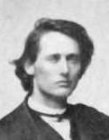
M.A. Luce
It was one of Hillsdale’s MoH winners that twigged me to the school and its Civil War history. Moses A. Luce‘s name came up when I was researching his commanding officer in the 4th Michigan at Antietam, Colonel Jonathan W. Childs. Luce was later awarded the Medal of Honor [citation] for retrieving and returning with a badly wounded fellow Sergeant – and Hillsdale man – under fire near Spottsylvania Courthouse in 1864.
He’s tolerable
16 March 2006
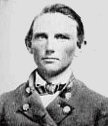
I came upon this picture of T.J. Goree on the Park Service Virtual Tour of Gettysburg the other day. I don’t know why, but I hadn’t noticed his face before. He’s one of “my guys” (a participant on the 1862 Maryland Campaign), you know.
________
I mean to provide at least a quick biographical sketch of all the officers in command of regiments or larger units at Sharpsburg (now expanding to cover the larger Campaign) on AotW. By now we’ve got at least a listing for nearly all of them; about 1,000 men. I’ve recently been “recruiting” from other groups, notably officers mentioned in reports and dispatches, and those in staff jobs on the campaign.
Lieutenant Goree was one of the latter: an aide-de-camp to MGen Longstreet. His photo was the trigger to do some reading and learn a little about him for the site. I updated AotW with a brief bio on him today.
His picture was a bit of a shock as I first saw it, though. I had a different face in my mind. I realized later that this was because of the way Goree was portrayed in The Movie:
 [
[