Good source, bad source
23 January 2007
I’ve been lured again by a pretty picture to post about being open to options when interpreting historical information. The image is from the Century Illustrated Monthly Magazine, May 1886:
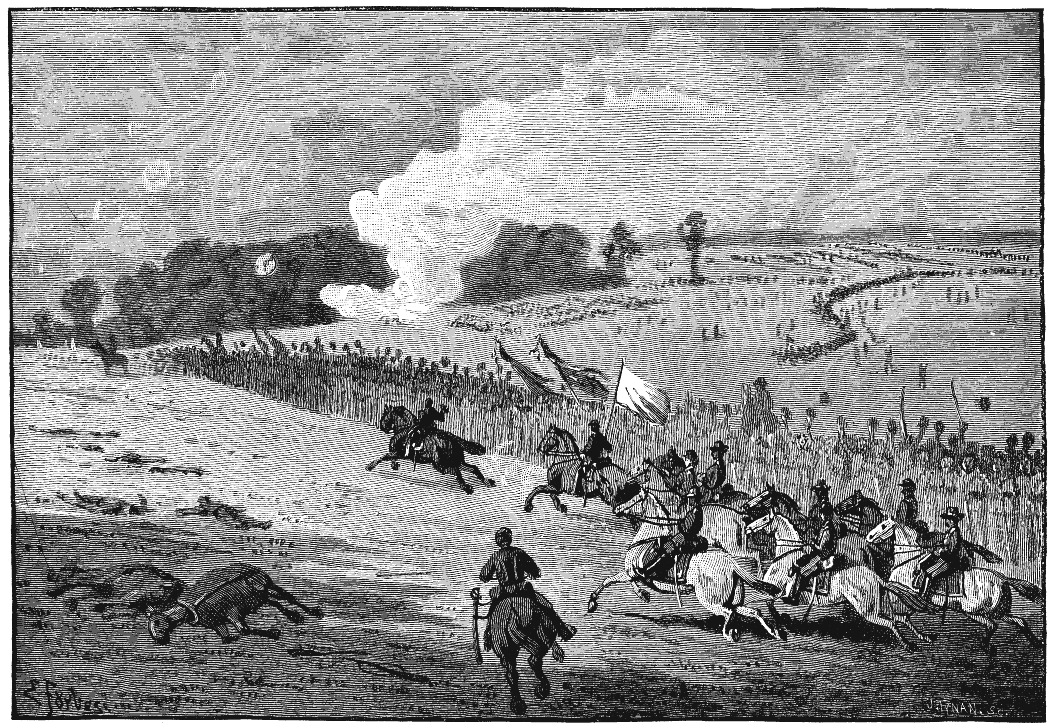
General McClellan riding the line of battle at Antietam.
(by Edwin Forbes, after his sketch made at the time.)
The troops were Hooker's and Sedgwick's, and the time about 11 A. M. of September 17. General McClellan rode his black horse, “Daniel Webster,” which, on account of the difficulty of keeping pace with him, was better known to the staff as “that devil Dan.”–EDITOR.
I think this is pure fantasy. I don’t remember another reference to such a ride, certainly not in advance of the Federal line between the East and West Woods, as shown here. However, combat artist Forbes was on the scene that day, so maybe I shouldn’t dismiss this image entirely …
Getting on with the War
19 January 2007

Pontoon bridge at Berlin, Md., October 1862
In the last week of October 1862, General George McClellan crossed the bulk of his Army of the Potomac into Virginia, ready to again do battle with General Robert E. Lee’s Confederate Army of Northern Virginia. It was the first significant movement of the Army–outside of the scrap at Shepherdstown on 19-20 September–since the Battle of Antietam.
Conventional wisdom has it that McClellan had stalled continuously since Antietam in defiance of President Lincoln’s impatience with the lack of pursuit of Lee’s battered ANV, and that the President fired the General immediately after the election in November for that lack of aggressive action.
Craighill: staff officers, a lighthouse, and copyfraud
8 January 2007
William Price Craighill (1833-1909) may have been something of a prodigy as he entered the US Military Academy at West Point at age 16 in 1849.

W.P. Craighill, c. 1849
He graduated in 1853, ranked second in the class which included famous ACW Generals Sheridan and Hood, and was commissioned a 2nd Lieutenant in the Corps of Engineers. At the outbreak of the Civil War he was an instructor at West Point, and though from Virginia, stayed with the Union, seeing War service on fortifications and other engineering projects across the US. His long Army career peaked in 1895 when he was appointed Brigadier General and Chief of Engineers, US Army.
I bring Craighill to you in several contexts – a kind of 3-for-the-price-of-one post …
 [
[