Parole of Daniel Daly, Pvt 50th GA
23 May 2022
Private Daniel Dailey (or Daly, Daily, Delay, Daylay, Delany), Company K, 50th Georgia Infantry was captured on South Mountain on 14 September 1862 and was issued a parole slip on 3 October at Boonsboro, MD. He was back with his Company by the end of the year and survived to go home in 1865.

The parole was signed by Major William Henry Wood, acting Provost Marshal General of the Army of the Potomac, and by Captain James Judson Van Horn. Both were West Point graduates and professional soldiers before the war. This document is from Private Dailey’s Compiled Service Records at the US National Archives, and is online thanks to fold3.
Orrin William Beach, First Sergeant of Company B, 34th New York Infantry, was in action at Antietam on 17 September 1862, and undoubtedly saw many of his “boys” killed or wounded as they fought beside the rookies of the 125th Pennsylvania in the West Woods just north of the Dunker Church that morning [map].
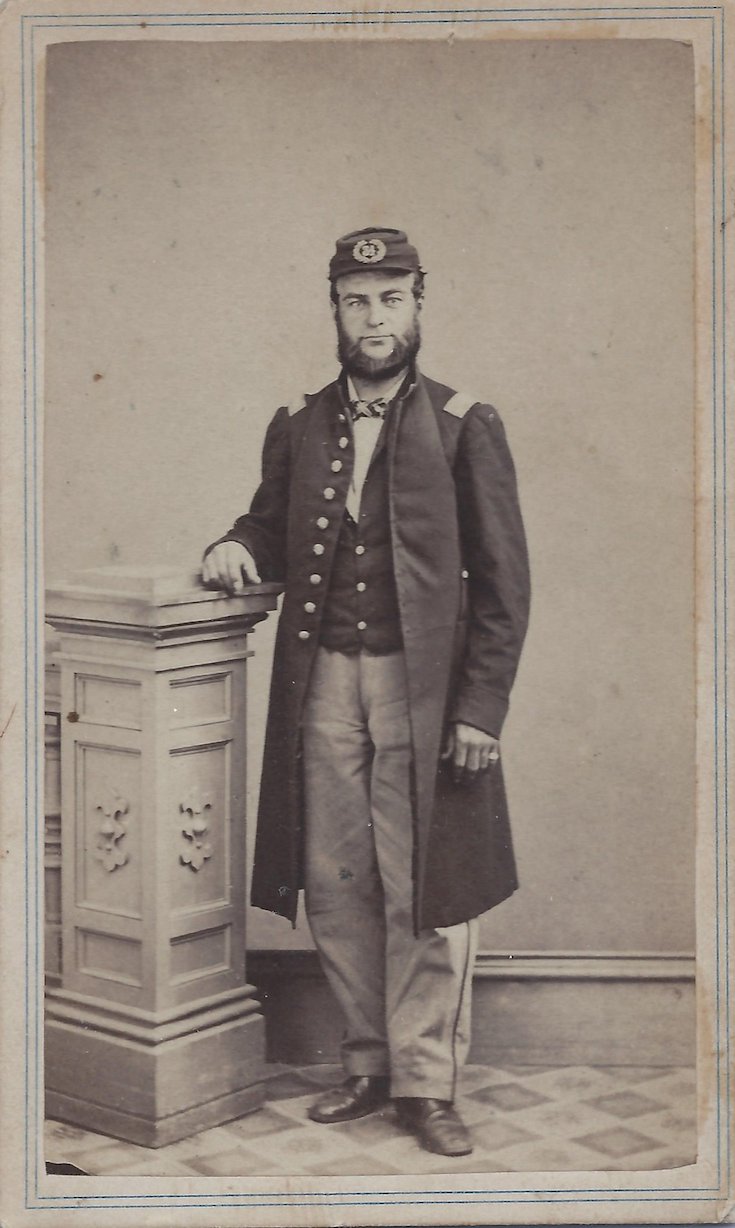
One of the men who fell near him was Corporal Arthur A O’Keefe of Company B. About 3 months later, a newly commissioned 2nd Lieutenant, Beach wrote Corporal O’Keefe’s father about his son’s death at Antietam. Here’s a typescript of that letter accompanied by a copy of a photo of young Arthur.

_________________
The CDV of Lt. Beach above is in the collection of the Wisconsin Historical Society in Madison. There’s also a lovely 1864 photograph of him as a Captain in the 16th NY Heavy Artillery in the NY State Military Museum.
The transcribed letter and O’Keefe photograph were shared to the FamilySearch database by Kathy McGerty.
Capt James W Forsyth, Provost Marshall (1863)
19 May 2022

This excellent photograph is in the collection of the Library of Congress and was taken in February 1863. It is of Captain James William Forsyth, then US Provost Marshall at Aquia Creek, VA – a large supply base for the Union Army. He’s sitting on a 50 pound crate of “Army Bread”, better known as hardtack, a staple of the soldiers’ diet.
Forsyth had been on the staffs of Generals McClellan and Mansfield on the Maryland Campaign, and was assigned to the Army of the Potomac’s Provost Marshall General after Antietam on 17 September 1862.
Probably typical of the work of the Provost Marshall after a battle, here’s an example of Forsyth’s signature on a parole given by Private John H. Reynolds of the 15th South Carolina Infantry who was captured at Sharpsburg (touch to enlarge). Slightly less typical, I expect, was Private Reynolds’ request to not be exchanged or returned.

That document is from Reynolds’ Compiled Service Record file, US National Archives. I got my copy from fold3.
 [
[