Wilbur Fiske Pope, a 20 year old private in Company A of the 13th Georgia Infantry was killed at Sharpsburg on 17 September 1862.
In a 17 November 1862 letter to her niece Martha Parks, his stepmother Susan Atkinson Pope, who had raised him from an infant, wrote:
… since my dear Wilbur’s death everything looks sad and gloomy. how hard it is to give him up, such a lovely youth. he was everything that a Mother’s heart could wish or desire. none knew him but to love him.
Capt. Mitchell wrote such a pretty letter after his death. I read two letters from William Gwynn telling how he was killed; said Wilbur was on his left side just in the act of caping his gun when the fatal ball struck him through the centre of his forehead. he fell forward on his side. said he looked right straight in his face the most imploringly, in a few moments he ceased to breathe. Billy said he never should forget the look that Wilbur gave him. said there was no doubt about his being fully prepared to die, oh that he could have died in my arms. the last letter i received from him was the very day that he was killed …
[I’ve added punctuation to make it a little easier to read]
A full transcription of this letter was posted to Facebook by Michael Parks for the Sons of Confederate Veterans Camp 1441, Midland, TX. The location of the original letter was not given.
In March 1862 22 year old Private John Barnett Mathews of the 13th Georgia Infantry wrote the Confederate President Jefferson Davis asking for appointment to a more important position so he could better help support his newly widowed and “nearly destitute” mother and 7 younger siblings back home in Heard County, GA.
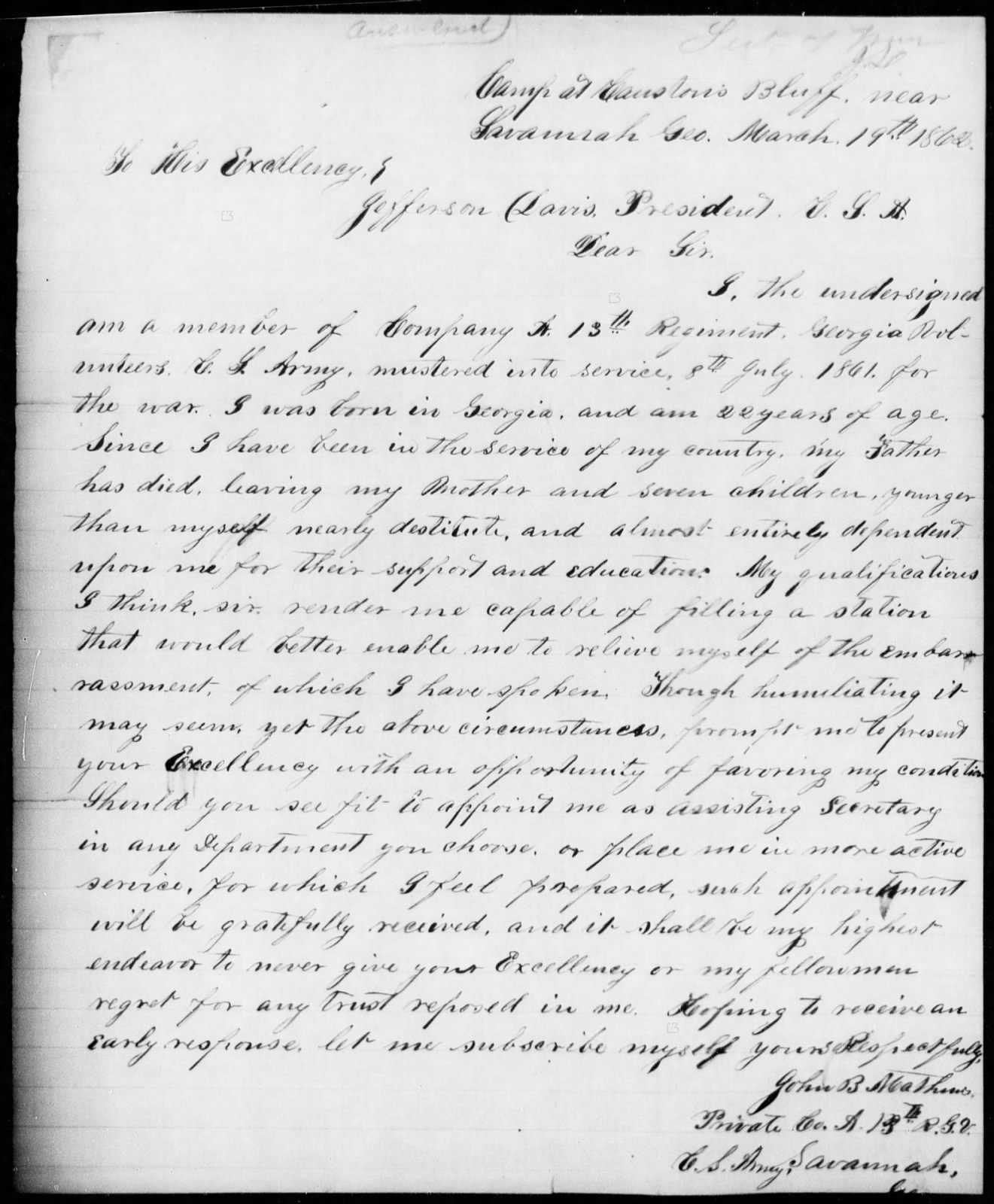
Private Mathews may have felt deserving of special treatment because he had attended medical school and was a school teacher before the war. He’d enlisted as a Private in June 1861 but, as he wrote the President,
My qualifications I think, sir, render me capable of filling a station that would better enable me to relieve myself of the embarrassment [the poverty of his family] of which I have spoken.
The letter was received in the office of the President on 25 March, and was apparently answered (those may be the President’s initials at top right), but the reply in not Mathews’ file. In any case, no new position was immediately forthcoming. Instead, he was elected by his Company to Junior 2nd Lieutenant in September 1862, and was their Captain by 1864.
If you are a student of US Naval Aviation, this 1911 photograph may be something like the holy grail.

Pictured is the Curtiss A-1 aircraft with Glenn H Curtiss at the wheel. Seated (L-R) are his students – young US Navy officers John Rodgers, John Henry Towers, and Theodore Ellyson – who qualified that summer as Naval Aviators #2, #3 and #1, respectively. The man standing at left is not identified, but is possibly Eugene Burton Ely (1879-1911), Curtiss’ pilot and a pioneer of Naval Aviation in his own right – the first man to take off from and land on a ship.
All of these men had tremendous flying stories and family histories – well worth a look when you have the time.
Rodgers (USNA 1903) and Ellyson (USNA 1905) were killed in plane crashes, in 1926 and 1928 respectively, but Towers (USNA 1906) had a 45-year Navy career culminating in 4-star Admiral’s rank (1945) and command of the US Pacific Fleet (1946).
Here’s Vice Admiral Towers (arrow) in a famous photograph of General Douglas McArthur signing surrender documents aboard USS Missouri (BB-63) in Tokyo Bay on 2 September 1945.

Bringing this back home …
Towers’ grandfather, Colonel John Reed Towers, commanded the 8th Georgia Infantry from 2nd Manassas to Appomattox, including in action with G.T. Anderson’s Brigade in the West Woods and on Piper’s Farm at Sharpsburg on 17 September 1862.
Here’s Colonel J.R. Towers, just after the Civil War.

Colonel Towers’ 2nd son and Admiral Towers’ father, William McGee Towers (1846-1912), was also a Confederate veteran. He served as an 18 year old cavalryman with General N.B. Forrest in 1864 and 1865. He lived to see his son fly.
___________________
Notes
More details of Admiral Towers’ Navy career are in a bio sketch from the Naval History and Heritage Command.
They are also the source of the Curtiss photograph above.
The 1945 photograph on the USS Missouri is online from the US National Archives.
The portrait of Colonel John R Towers is thanks to family genealogists via RootsWeb.
 [
[