A full and eventful life: E. A. Y. Osborne
3 October 2006
Let me introduce you to “Gus” Osborne, late of North Carolina and Confederate service.
As a 25 year old Captain, he briefly led the 4th Regiment of North Carolina State Troops in action in the Sunken Road at Sharpsburg on September 17th, 1862, before being struck down and captured by the enemy there. He survived both that experience and the War, however, living to be nearly 90 years of age.
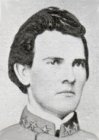
Edwin Osborne, 1864-5
Edwin Augustus Young Osborne was raised by his “pioneer” father, Dr. Ephriam Osborne, in the wilds of Alabama, Arkansas, and Texas in the 1840s and 50s before coming to North Carolina at age 22. Family lore has it that he walked alone from Texas to an aunt’s in Charlotte, and that he enrolled in a military school at Statesville.
He probably helped raise a company of soldiers in Iredell County, and was commissioned Captain in what became Company H of the 4th NCST as that unit was organized in May of 1861. He served with his Regiment in the campaigns of the Confederate Army of Northern Virginia thereafter. He was wounded in action at Seven Pines in May 1862, but was back with his unit in time to join the Maryland Campaign.
Captain Lewis and friends in high places
7 September 2006
Doing research into the people and events of the Maryland Campaign is often a game of large effort invested for little return. In some cases, though, the reverse is true, and the clues revealed can be a bit overwhelming.
One such case is a story I’ve been working on and off for about a year now. It centers on Captain Enoch E. Lewis, Company K, 71st Regiment Pennsylvania Volunteers. Or maybe it centers on President Lincoln, I’m not sure yet. All I have right now is a collection of hints and pointers to interesting relationships and events.
The bare bones are these:
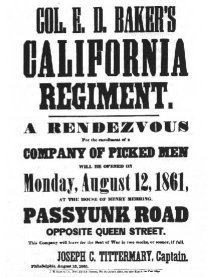
Lewis, a young lawyer of privileged background, of Philadelphia society, joined Oregon Senator Edward Baker‘s famed ‘California Regiment’ in 1861 as Captain of Company K. He served bravely in action through the battle of Antietam (September 1862), where he briefly succeeded to command of the regiment as senior officer present.
There is significant evidence that he and (by then) Major R. Penn Smith, another Philadelphia dandy who was the regiment’s first Adjutant, had clashed personally and professionally. Was it a long-standing feud? Slights given and received while in service? Perhaps both, I can’t tell yet.
Following Antietam, Captain Lewis was reported absent and shortly afterward charged–presumably by Major Smith– then arrested and court-martialled for being absent without permission and conduct ‘unbecoming an officer’ and ‘prejudicial to good order and discipline’.
McClellan, beloved of the troops
16 August 2006
I don’t intend to make a habit of simply linking to other blogs, but in this case I hope you’ll let me slide.
As sighted on the latest History Carnival, “Greenman Tim” Abbot has written a thoughtful piece called “Little Mac” Attack: History vs. the Soldier’s View on his Walking the Berkshires blog. Nothing earth-shattering, perhaps, but a different perspective from the average. Almost never a bad thing.
He gives a nice synopsis of the subject:
I have often wondered at the disconnect between the deep affection the Army of the Potomac had for its ill-starred commander and the verdict of history. His men by their own accounts adored him. Lincoln was certain the soldier votes of McClellan’s veterans would cost him re-election in 1864 when “Little Mac” ran on the Democratic ticket. Yet armchair generals and Civil War buffs alike condemn McClellan as a failed and self-promoting army commander who may have been an efficient administrator but who consistently over-estimated his foes and was outgeneraled time and again on the Peninsula.
He quotes from a letter of a Captain Read (of BGen Brooks‘ staff) talking about McClellan’s having been relieved of command of the Army of the Potomac soon after Antietam, in November 1862:
“… It is the feeling in the camp that a deep act of injustice has been done, purely from political motives, and there is a general indignation manifested. The demonstrations of affection with which little “Mac” was received by his troops as he paid them a farewell visit it is beyond the power of pen to describe …”
Later Tim makes a simple statement that also summarizes my own take on General McClellan
McClellan is a complex figure.
Aren’t we all?
 [
[