Col Thomas M Anderson and family (c. 1897)
24 January 2023
Captain Thomas McArthur Anderson commanded a battalion of the 12th United States Infantry in action between the middle bridge over the Antietam and the town of Sharpsburg on 17 September 1862. Many years later, after a long and arduous Army career, he was Colonel of the 14th US Infantry and commanded Fort Vancouver, Washington (1886 to 1898).
Here he is with his family on “Officer’s Row” there in late 1897 or early 1898, before he was appointed Brigadier General and deployed to the Philippines on Spanish-American War service.

(back, left to right)
Thomas McArthur Anderson (1836 – 1917)
Elizabeth Van Winkle Anderson (1850-1914)
Charles Van Winkle (1821-1907)
(children, by age; I can’t tell the daughters apart)
Arline Anderson (later Cairns, 1871-1932)
Mary Anderson Allen (1874-1904)
Thomas McArthur Anderson, Jr. (1875-1936)
Elizabeth Anderson (later Gauld, 1875?-1944)
Van Winkle Anderson (1877-1960)
Irmengarde Anderson (later Patten, 1879-1945)
dog, name not known
Notes
This lovely picture accompanies a piece from the US Park Service called The Waking of a Military Town: Vancouver, Washington and the Vancouver National Historic Reserve, 1898-1920 [online in PDF]. The original photograph is in the University of Washington Libraries, Special Collections (UW475).
There’s another family portrait of the same period – and much more about the Andersons – in the 1973 monograph Thomas Anderson: First U.S. General Overseas for the Fort Vancouver Historical Society by General Anderson’s grandson Dr. Charles Anderson Gauld (1911-1977) [online PDF].
Thomas McArthur Anderson, Jr. had 4 years enlisted service in the 4th US Cavalry in Texas before being commissioned 2nd Lieutenant, 8th US Infantry on 8 June 1897, the uniform in which he is seen in the family photograph here. He served through WWI and retired as a Colonel.
Jacob Ford Kent (c. 1863, 1885, 1891, 1898, c. 1918)
23 January 2023

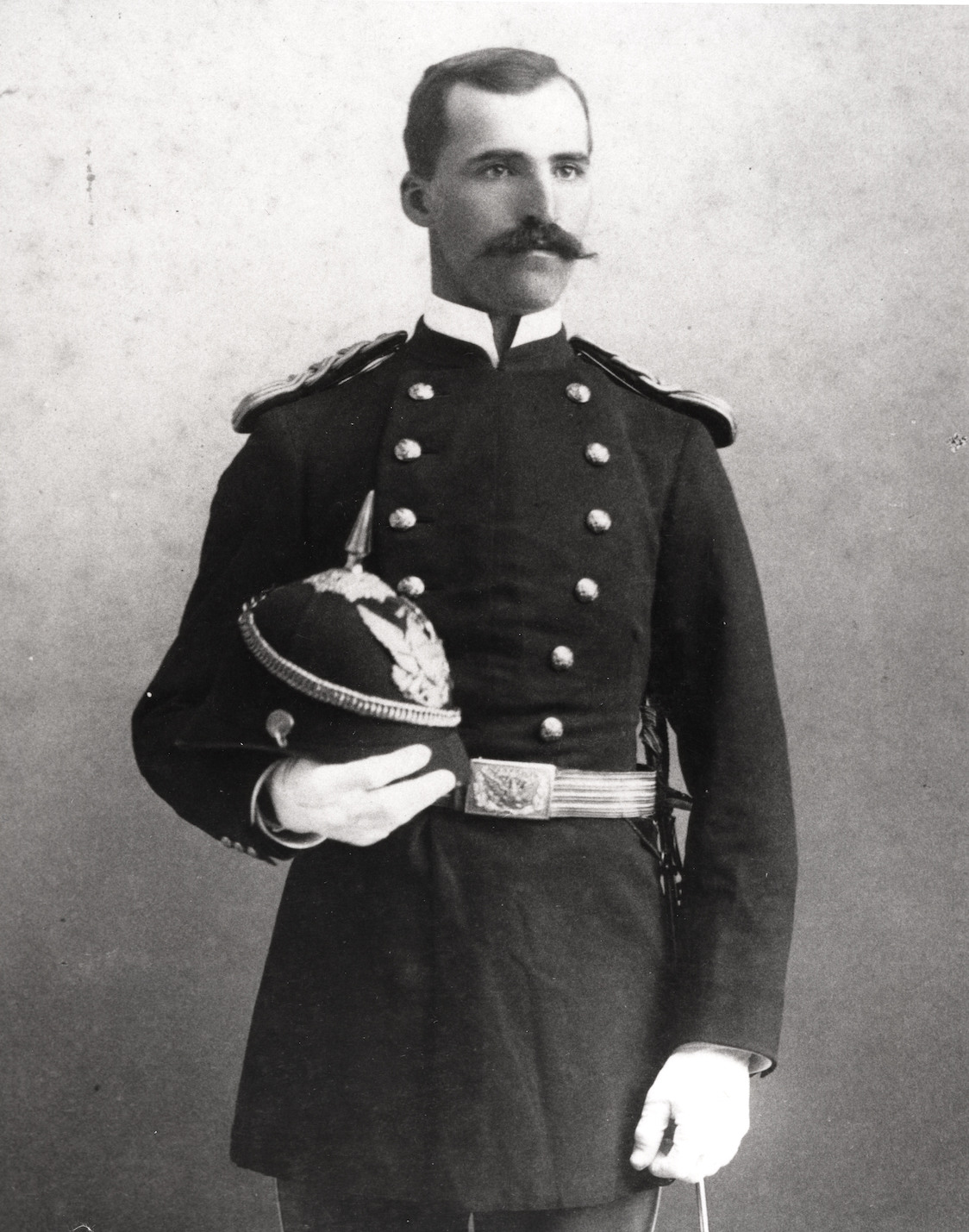
United States Military Academy graduate J. (Jacob) Ford Kent (May 1861) had a very long, impressive military career and maintained an impressive mustache for even longer.
He was first in combat at Bull Run in July 1861 and was wounded and captured there, but was exchanged in time to rejoin his regiment, the 3rd United States Infantry, on the 1862 Maryland Campaign. He was a staff officer for most of the rest of the Civil War and in nearly continuous action to the end.
He was afterward an instructor at the Academy and served at posts in the West and South over a span of nearly 30 years right up to the Spanish-American War.
Here he is, mid-career, as a Captain in dress uniform in about 1885.
In January 1891 he was serving again as an Inspector General, by then a Major, and his boss General Nelson A Miles detailed him with another officer, Captain Frank D. Baldwin, to investigate the recent fight of the 7th US Cavalry at Wounded Knee in South Dakota.
His facial hair makes him easy to pick out in this photograph of General Miles and staff taken that month at the scene of what has since become known as the Massacre at Wounded Knee (touch to enlarge).

On 1 July 1898, by then a Brigadier General of Volunteers, he led a Division in the famous and successful charge up San Juan Hill near Santiago, Cuba in the war with Spain. Still sporting a serious mustache.
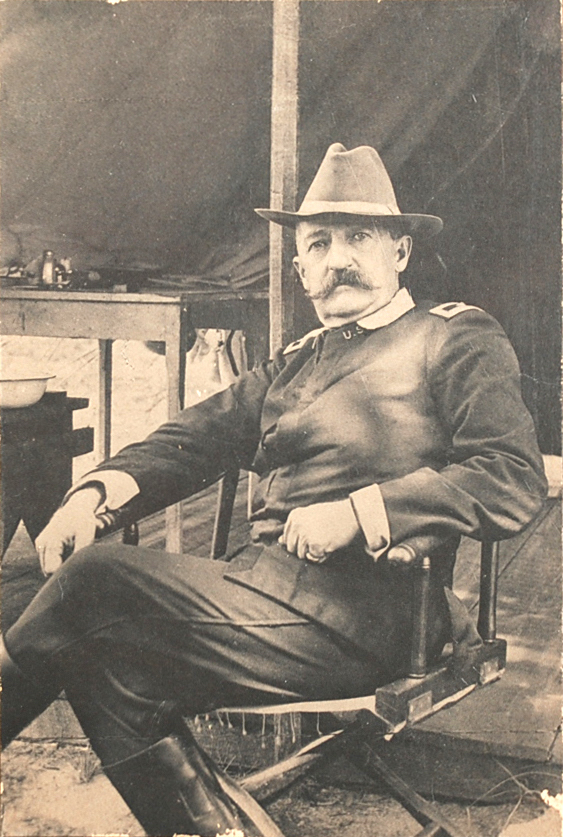
He retired as a Brigadier General, US Army in October 1898 and still looked to be in fighting shape to near the end of his life in 1918. Here he is in a late-life photograph published by the USMA Association of Graduates in 1919:

_________________
Notes
The photograph at the top is a CDV of Kent, probably taken while he was serving as Lieutenant Colonel and Inspector General of Volunteers with the Sixth Army Corps, from 1863 to 1865; it was sold by The Horse Soldier of Gettysburg.
The 1885 photograph is from the National Park Service, Lake Roosevelt National Recreation Area, Washington, and was probably taken while Captain Kent was at Fort Spokane. It’s online in the NPGallery.
The 1891 group photograph of General Miles and staff was shared online by Sam Russell in a piece called Wounded Knee Investigation on his Army at Wounded Knee blog; an excellent source for much more detail about the Wounded Knee investigation and outcomes. Here’s Mr Russell’s caption for the photograph:
George E. Trager’s “Gen Miles and Staff during Late Indian War at Pine Ridge Agcy,” January 13, 1891. From left to right are Captain Ezra P. Ewers, Lieutenant John S. Mallory, Captain Francis E. Pierce, Lieutenant Colonel Dallas Bache, Captain Francis J. Ives, Major Jacob Ford Kent, Lieutenant Colonel Henry C. Corbin, Major General Nelson A. Miles, Captain Frank D. Baldwin, Lieutenant Sydney A. Cloman, Captain Charles F. Humphrey, and Captain Marion P. Maus. General Miles was the commanding general of the Division of the Missouri.
General Kent’s 1898 photograph was sold at auction by One Of A Kind Collectibles, Coral Gables, FL in 2012.
The last photograph is from the Fiftieth Annual Report of the Association of Graduates of the United States Military Academy, June 10, 1919.
A. Lincoln to JAG J. Holt 18 March 1863
22 January 2023
John Benson Williams, US Military Academy Class of May 1861, was First Lieutenant, 3rd United States Infantry at Antietam in September 1862, and commanded Company G there.

Antietam was the peak of his young military career, however, as he was sentenced by a Court Martial to be dismissed from the service in February 1863, having “left his command on the battlefield and returned to Washington, without leave and in known violation of orders and of his duty.”
In this note of 18 March 1863, President Lincoln, famously soft-hearted in these matters, asked Army Judge-Advocate General Joseph Holt to see if there weren’t mitigating circumstances that would allow him to return Lieutenant Williams to duty. He was presumably referring to Williams having been ill since sometime in December 1862:

The answer came back in the negative, Holt reiterating that Williams “has shown himself disqualified for the profession of arms,” so on 11 April 1863 the President endorsed the sentence of the Court, writing “I decline to interfere in Behalf of Lieut. Williams.”
_________________
Notes
Lieutenant Williams’ picture above is from a CDV sold on ebay, date unknown; it was captured and archived by Worthpoint.
The Lincoln letter was sold at auction by Sotheby’s in 2008. The image of it is from Sotheby’s, and details surrounding it are from Dr. James M. Cornelius, Curator, Lincoln Collection, Abraham Lincoln Presidential Library.
The original of this letter is again up for sale (as of January 2023), by Houle Rare Books and Autographs, with an online listing through Abe Books.
The President’s endorsement of 11 April 1863 is found in the Collected Works of Abraham Lincoln (1953), Vol. 6, pg. 169.
 [
[