I already get 5 bars …
17 March 2008
WASHINGTON, The site of the single bloodiest day in American history is under siege, threatened by a 120-foot cellphone tower, says a preservation group.
This year’s Endangered Battlefield Report from the Civil War Preservation Trust leads off with the story of a planned cellphone tower for Antietam. If you read newspapers you’ve seen many lead paragraphs like that above from USA Today March 12.
Liberty Towers LLC says the 120-foot structure – it would extend 30 feet above the treeline to the west – would be disguised as a farm silo to blend in with the rolling farmlands of Western Maryland. But opponents say it would overwhelm a battlefield seen nationally as a model of historic preservation.
“One of the reasons that Antietam is so well-known and so well-respected is the fact that here, when you stand on the battlefield, what you see is a very rural environment that hasn’t been impacted by commercial development,” said John Howard, superintendent of Antietam National Battlefield…
Mike Hofe, president and chief operating officer of Liberty Towers, has described the structure as a “stealth tower” that would have minimal impact on battlefield vistas. He says the proposal remains in the “early planning stages”; Liberty has yet to file for permits … (Baltimore Sun, March 14)
Dr Tom Clemens, President of Save Historic Antietam Foundation (SHAF) noted that the threat of a cell tower has been seen before near Sharpsburg, and
I observed the test for this tower back in early January [2008]. They put up a balloon to the height of the proposed tower and it was awful. You could see it from all over the place. Not just from the battlfield, but all over Sharpsburg. SHAF
wrote a letter protesting the tower, as did the NPS [National Park Service] … no reply yet to either of us.
The Hagerstown Herald-Mail story adds:
National Park Service officials were notified in December 2007 of a proposal to erect a stealth cell tower south of the battlefield off Mondale Road in Sharpsburg, park Superintendent John Howard said Thursday.
“Any modern intrusion on it really detracts,” Howard said.
Can you help? Contact:
The Civil War Preservation Trust (CWPT)
Save Historic Antietam Foundation (SHAF)
And let your US Representative or Senator know you want them to bring pressure to bear to protect the Battlefield.
Behind the curtain
5 March 2008
Buried below the fold here on the blog are a number of fantastic discussions growing from older biographical posts. As site owner I can see these conversations as they happen, but I’m not sure either of our other readers notice. Hence this pop-up flag. That, and I’m not getting any writing of my own done …
Notable lately have been contributions from Morrisons and a Lewis. Look in comments more recently, too, for insights from descendents of Weisiger and Clark. Old mysteries solved, but new avenues opened as well, so please jump in if you can help.
The many of the Morrison Clan who have stopped in to add information have driven the comment count on last year’s piece on patriarch Robert Hall Morrison to first place all-time. I’m amazed by the rich detail these family historians have brought to the story, and recommend you get caught up if you’ve not been following the threads there.
Anne Morrison Garber also seeks help locating Morrison scholar Sarah Marie Eye’s new email address … anyone?
Enoch Lewis’ descendent Annie Lewis teases of connections to the US Military Academy at West Point in a new comment. Do please speak up if you know where that hint leads. Captain Lewis’ case is still a tangle of unanswered questions of politics and motivation to me.
Oh for more time to research …
12th Virginia Infantry in Maryland
20 February 2008
The sad story of the officers and men of the 12th Virginia Infantry Regiment of late 1862 is typical for a number of the tattered units of the Confederate Army of Northern Virginia (ANV) who were at Sharpsburg that September.
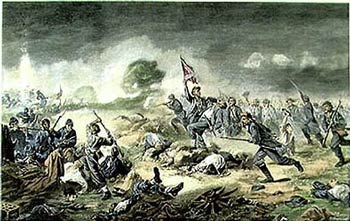
The Crater (c. 1866, J. Elder)
The Fourth Battalion as it left Petersburg on the 20th of April, 1861, was made up of the flower of the manhood of the Cockade City. After four years of service it had been so decimated by disease, by death, by promotion, and by transfer that it showed scarcely more than a skeleton of the original body. It was the nucleus upon which was formed the famous Twelfth Virginia Regiment, whose banner bore the device of almost every field on which the Army of Northern Virginia grappled with the enemy, from Seven Pines to Appomattox, and whose flag, stained with the smoke of battle and shredded by ball and shell, was never surrendered, but torn into slips and buried in the bosoms, right over the hearts, of the veteran survivors.
 [
[